
Kadamba’s Integrated Bio-Rhythm Concept is a whole-person wellness mapping framework designed to read how the body’s regulation, energy stability, neuro-emotional state, and lived patterns evolve over time. Instead of relying on a single test or one clinical lens, Kadamba converges multiple evidence streams to construct a multi-layer bio-rhythm profile for each individual.
The core principle is simple: wellness is dynamic, so a reliable wellness profile must reflect interactions across physiology, mind-emotion, and systemic timing—not isolated symptoms.
This is a high-resolution wellness-profiling and decision-support system, built on converging parameters and validated internal interpretation frameworks. It is designed to complement (not replace) standard medical diagnosis, especially for serious conditions. Its reliability comes from multi-modal convergence: when independent signals point to the same pattern, interpretive precision increases.
An integrated bio-rhythm profile is a synchronized map of functional balance across specific domains—not a single test result, but a convergence model in which each modality reads a different layer of wellness.
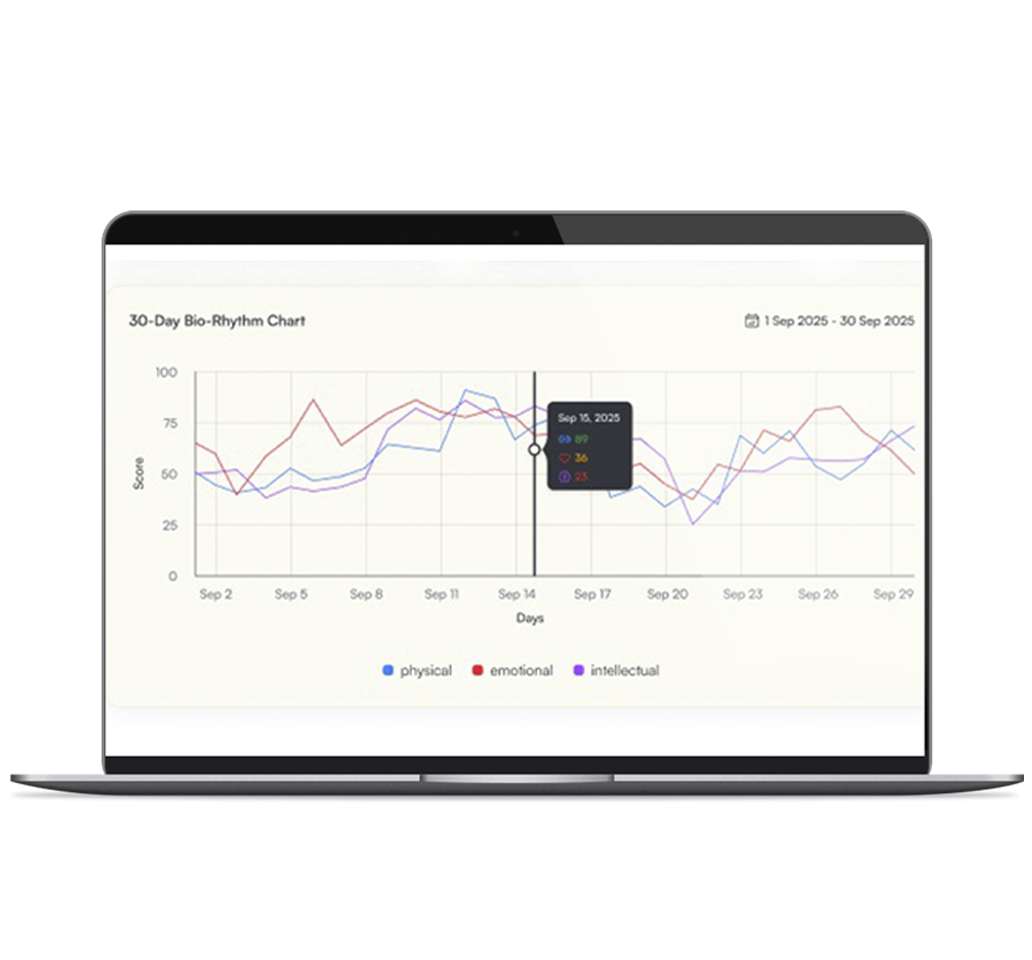
Kadamba’s patented diagnostic engine fuses multi-stream clinical diagnostics, pulse-wave and cardiac rhythm analytics, biophoton and organ-frequency signatures, neuro-emotional fingerprinting, chronobiological timing, and patterned behavioural inputs to generate high-resolution, predictive, and personalized regulatory health intelligence.

Captures pulse-wave features to interpret systemic regulation, constitutional tendencies, and time-linked functional imbalances.

Measures biophoton/energy emissions to infer energetic stability, stress signatures, and coherence in the regulatory network.

Extracts organ-specific frequency signatures to detect subtle deviations before clinical expression.

Maps innate cognitive style, emotional regulation, stress sensitivity, and behavioral drivers influencing wellness trends.

Adds a time-based constitutional lens for rhythm tendencies and long-cycle vulnerability windows.

Provides supportive patterned inputs for behavioural rhythm and lifestyle alignment.

Generates cardiac performance markers and rhythm-linked risk indicators relevant to metabolic and vascular resilience.

Clinically validated, data-centric diagnostics integrate quantitative phenotyping, imaging (MRI, CT/X-ray, USG), ECG, and bio-molecular panels with longitudinal clinical and lifestyle data.
Each diagnostic modality generates high-dimensional structured parameters encompassing physiological waveforms, energetic flux indices, organ-specific frequency signatures, neuro-emotional trait vectors, cardiac rhythm dynamics, and chronobiological timing markers. Kadamba’s analytical workflow applies a multi-layered signal-integration architecture aligned with international clinical informatics standards.

Data Normalization: Heterogeneous data streams are normalized into interoperable computational domains—somatic, organ-functional, cardio-metabolic, neuro-cognitive, psycho-emotional, and chrono-biological—using scale harmonization and feature-space alignment.
Signal Validation: Cross-modal signal validation and redundancy filtering are performed through Bayesian and correlation-weighted models to suppress modality-specific noise and enhance true physiological convergence.
AI Relationship Modeling: AI-assisted relationship modelling maps non-linear interactions across systems—stress-axis modulation of gastrointestinal rhythms, neuro-emotional sensitivity coupling with cardiac coherence, and circadian misalignment influencing metabolic control.
By integrating multi-dimensional biological, behavioural, and temporal data, Kadamba’s holistic analytics framework constructs individualized regulatory maps that quantify system-level dynamics across metabolic, neuro-endocrine, immune, cardiac, and psycho-emotional axes. Advanced feature extraction and systems-modelling algorithms identify personal baselines, coupling patterns, and non-linear drift trajectories.This enables stratified risk profiling, precision phenotyping, and time-aligned intervention planning, aligning prevention, correction, and lifestyle modulation with each individual’s intrinsic functional architecture, adaptive capacity, and long-term resilience.








Conventional wellness systems are often single-axis—focusing on labs, symptoms, psychology, or energy independently. Kadamba’s approach is multi-dimensional, network-driven, and convergent, integrating molecular, physiological, energetic, and neuro-behavioural signals to create predictive, personalized health intelligence.

Quantitative evaluation of organ-specific biomarkers, pulse-wave morphology, advanced cardiac metrics, imaging modalities (MRI, CT, X-ray, USG), and longitudinal lab baselines. Coupled with bio-molecular panels, this captures systemic and subcellular functional status

High-resolution mapping of bio-energetic coherence, stress-response networks, mitochondrial and cellular energy balance, autonomic regulation, and early subclinical drift signals. AI-driven analytics identify compensatory patterns and resilience thresholds.
Integration of neuro-emotional fingerprinting, cognitive-behavioural rhythm profiling, chronobiology, lifestyle-linked patterns, and environmental timing influences. This elucidates systemic vulnerabilities, individual resilience, and long-term health trajectories.

Data from molecular, physiological, energetic, and behavioural streams are normalized, cross-validated, and fused using AI-assisted relational modelling. Convergent insights generate an Integrated Bio-Rhythm Map displaying stability, drift patterns, early imbalance detection, resilience capacity, and intervention optimization windows.